How Does Bok CAD Realize Full Automation in Pattern Workshops?
As the apparel industry increasingly moves toward small-batch quick response, flexible customization and frequent new product launches, the traditional pattern making method, which relies on experience, hand-drawing and point-by-point modifications, has long been unable to keep up with the pace of the market. Parametric pattern making is becoming the mainstream trend in apparel pattern making, and even the core foundation of future pattern technology. With the parametric system of Bok CAD, the full automation of apparel pattern workshops is no longer just a concept, but tangible productivity that can be directly implemented.

What Is Parametric Pattern Making?
In simple terms, parametric pattern making breaks down a garment pattern into a set of editable, linked, and computable digital parameters. Garment length, bust, shoulder width, armhole depth, bust-waist difference, back crotch inclination of trousers, dart value, seam allowance… all key data that determine the shape of the pattern are set as variables, with scientific structural logic established between them.
In traditional pattern making, changing one dimension affects the entire pattern: side seams, armholes, darts, and curves all have to be adjusted manually. This process is not only slow but also error-prone, relying entirely on the personal experience of the pattern maker. Parametric pattern making is different: changing one parameter triggers an automatic, full-pattern update. For example, by simply entering a new bust or waist measurement, the system automatically calculates the bust-waist difference, adjusts dart values, and corrects shoulder slope and armhole shape. The entire pattern is updated instantly, ensuring consistency and efficiency, and eliminating the inefficient work of repeated drawing and revision.
At its core, parametric pattern making upgrades pattern making from manual drawing to digital modeling, turns experience into rules, and transforms patterns into reusable, inerrable digital assets.
Why Is the Future of Pattern Making Definitely Parametric?
Trends in the apparel industry are clear: small-batch quick response has become the norm, demand for personalized customization has surged, and frequent changes in multiple sizes and pattern variations for the same style are increasingly common. Traditional pattern making is clearly struggling to keep up. Parametric pattern making precisely addresses these pain points.
It allows a single master pattern to quickly generate full-size grading with accurate and consistent measurements, eliminating errors caused by manual grading. It enables rapid style changes: the same design can be easily adjusted in length, silhouette, and details, greatly shortening the R&D cycle. It helps enterprises build their own pattern libraries, allowing new pattern makers to get started quickly without being restricted by the experience of senior technicians.
More importantly, parametric data can be seamlessly connected with 3D fitting, intelligent marker making, and CNC cutting machines, forming the most critical link in the entire digital production chain.
It is fair to say that without parameterization, there would be no real intelligent pattern making; and without intelligent pattern making, it would be extremely difficult for pattern workshops to achieve automation.
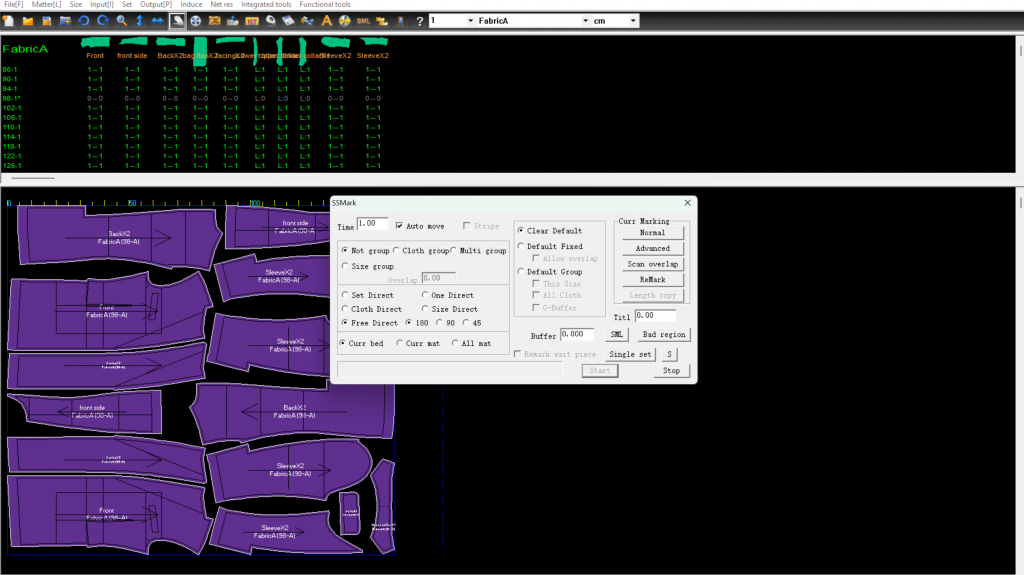
Bok CAD Parametric Pattern Making: Making Full Automation of Pattern Workshops a Reality
In the field of intelligent apparel CAD in China, Boke is a representative system that deeply implements parameterization and truly supports full automation in pattern workshops. It is not a simple digital drawing tool, but a complete parametric intelligent pattern system. In Bok CAD, all pattern structures are parametrically linked. Changes to the back crotch inclination of trousers will automatically drive updates to the back crotch curve, waistline lift, and side seam lines. Adjustments to the bust-waist difference will let the system automatically match front and rear dart values and waistband dimensions, eliminating the need for manual point-by-point revision and greatly reducing pattern modification time and error rates.
It comes with a rich library of components and styles, including collars, sleeves, pockets, plackets and more, which can be used like building blocks. New styles can be quickly generated through parametric fine-tuning, exponentially improving the efficiency of basic pattern making. The grading process is fully automatic. By simply importing the size chart, the system instantly completes grading for all sizes based on the parametric model, ensuring consistent fit and aesthetics across every size. It easily handles team uniforms, multi-size e-commerce styles, and special-figure customization.
Marker making is also seamlessly integrated with parametric patterns. When patterns are modified, markers update automatically. Combined with intelligent marker making algorithms, it greatly saves fabric and shortens marker making time. From pattern making, grading to marker making, data flows seamlessly throughout the entire process, eliminating repeated file conversion and redundant operations.
More importantly, Bok’s parametric patterns can be directly connected to the production end, with data fully linked to cutting beds and sewing equipment, transforming pattern workshops from manual operation to automatic workflow. Once an order is received and size data is entered, the system automatically generates patterns, completes grading, and arranges markers, truly approaching the unmanned, automated modern pattern workshop.

Parameterization Does Not Replace Pattern Makers, But Upgrades Pattern Workshops
Many people worry that parameterization and automation will replace pattern makers.
On the contrary, parameterization frees pattern makers from repetitive and tedious drawing and revision work, allowing them to focus on pattern optimization, style innovation, and structural research and development. Pattern makers are no longer just “drawing workers” but creators of pattern rules, builders of digital models, and controllers of product style.
For enterprises, parametric pattern making means more stable pattern quality, faster new product launches, lower trial-and-error costs, and stronger customization capabilities. In an increasingly competitive apparel market, this is core competitiveness.
Garment pattern making is undergoing a transformation from experience-driven to data-driven operations, and parameterization lies at the heart of this revolution. It is not an optional upgrade, but an inevitable path for the future of pattern making.
With mature parametric technology, Bok CAD has turned the vision of “full automation of pattern workshops” into an implementable solution, making pattern creation smarter, grading more efficient, and production smoother.
For apparel enterprises, the earlier they embrace parametric pattern making and build their own intelligent pattern workshops, the more proactive position they will occupy in the new round of industrial upgrading.